
Introduction
There are many standards across the globe covering the range of respiratory protective devices (RPDs) on the market, with individual standards for each type of RPD e.g., EN 149:2001 + A1:2009 (CEN, 2009) for filtering facepieces and EN 137:2006 (CEN, 2006) for self-contained breathing apparatus. Assigned protection factors (APFs) are used to assist in the selection of adequate RPD, with APFs for different types and classes of RPD being derived and published by both health and safety regulators and standards institutes (CEN, 2005; HSE, 2013; OSHA, 2006, 2009). A definition of an adequate RPD is given in the European standard for RPD selection, use and maintenance, EN 529 (CEN, 2005) as ‘A respiratory protective device is considered adequate if it has the capacity to reduce the wearer’s exposure to a hazard to acceptable levels (e.g. to comply with occupational exposure limit values)’.
A definition of APF is given in the European standard for RPD selection, use and maintenance, EN 529 (CEN, 2005) as the ‘level of respiratory protection that can realistically be expected to be achieved in the workplace by 95% of adequately trained and supervised wearers using a properly functioning and correctly fitted respiratory protective device and is based on the 5th percentile of the Workplace Protection Factor (WPF) data’. There are many different definitions of APFs from different countries and organisations, all with the same meaning but with slight differences.
APFs are different worldwide with examples given in Table 1 (CEN, 2005; OSHA, 2024). The variations are a result of how the different countries derived their APFs, which have often used Workplace Protection Factor (WPF) studies, Simulated Workplace Protection Factor (SWPF) studies, the application of safety factors to Nominal Protection Factors (NPF), and in some cases, professional judgment where there was a lack of data.
A new suite of RPD standards have been developed under International Organization for Standardisation (ISO) sub-committee SC15, that were published in January 2021. These standards take a different approach and instead of having individual standards for each type of RPD, e.g., EN 149 and EN 137, the performance requirements for all types of RPD are covered under the same suite of ISO standards (ISO, 2021a, 2021b, 2021c, 2021d, 2021e, 2021f, 2021g, 2021h):
-
General requirements for RPD are described in ISO 17420-1 (ISO, 2021a), including classification, marking and information to be supplied by the manufacturer.
-
Specific requirements relating to filtering RPD are described in ISO 17420-2 (ISO, 2021b), including ‘work of breathing’ (breathing resistance) and CO2 concentration limits.
-
Specific requirements relating to supplied breathable gas RPD are described in ISO 17420-4 (ISO, 2021c), including flexibility of hoses and cylinder valves.
-
The standards ISO 17420-5 to 9 (ISO, 2021d, 2021e, 2021f, 2021g, 2021h) describe requirements for filtering RPD and supplied breathable gas RPD with the following special applications:
-
Part 5 – Filtering RPD and supplied breathable gas RPD for fire and rescue use (ISO, 2021d).
-
Part 6 – Filtering RPD and supplied breathable gas RPD for escape use (ISO, 2021e).
-
Part 7 - Filtering RPD and supplied breathable gas RPD for use in marine, mining, welding and abrasive blasting (ISO, 2021f).
-
Part 8 - Filtering RPD for use with chemical, biological, radiological and nuclear (CBRN) and radiological-nuclear (RN) (ISO, 2021g).
-
Part 9 - Supplied breathable gas RPD for use with chemical, biological, radiological and nuclear (CBRN) (ISO, 2021h).
-
-
The standard ISO 17420-3 (ISO, 2012) details the requirements for threaded connections.
Standards Australia and Standards New Zealand are currently going through a transition period to adopt the ISO standards, with their old standards set to be superseded on 1 January 2030 (SA, 2025). The European Committee for Standardisation (CEN) do not have a planned implementation date, but it is likely that a lengthy transition period will be required to allow for familiarisation, revision, and national vote. There is little information about the ISO standards being adopted elsewhere across the globe.
RPD is selected using the APF for the type and class of RPD in order to reduce the residual exposure to below the relevant occupational exposure limit (OEL), where assigned, for the particular hazardous substance used (or generated) for the work activity being undertaken. The current variation in APFs across different countries does not lend itself to the development of a worldwide harmonised RPD performance requirement standard or RPD selection process.
Under the new suite of ISO RPD performance standards (ISO 17420 series), a classification system was established with six ISO Performance Classes (ISO PC). A new indicator of in-use performance values was generated, referred to as ISO Protection Levels (ISO PL) (see Table 2). This indicator of in-use performance is to be determined by a laboratory Total Inward Leakage (TIL) test. A TIL test is a measure of the protection provided by the RPD by measuring the concentration of a challenge agent inside and outside of the RPD, while under laboratory conditions.
Currently, there is limited information about how the new ISO PL system will be implemented to correctly select adequate RPD for a particular task. The new ISO PLs have been derived by the process of ‘expert judgment’ rather than comprehensive and robust workplace performance data. This deficiency was recognised by the ISO SC15 committee developing the new ISO RPD performance standards, as well as national standards bodies worldwide, and it was acknowledged that the proposed ISO PL system required validation. The hope was that once the ISO RPD performance standards were published, research institutes would start to carry out testing to validate the ISO PL system, and that this would be driven by manufacturers getting products certified to the new ISO RPD standards.
Worldwide, there are many initiatives to improve RPD selection and use. All routes to RPD selection rely fundamentally on the APFs. If these are to be replaced by the ISO PLs then it is essential that these values are robust and validated.
Aim
The aim of this research was to provide initial ISO PL validation data for five RPD types currently on the market, and to compare against current APF values.
Method
TIL testing was undertaken according to the requirements given in ISO 17420-1 and the test method given in ISO 16900-1 (ISO, 2019). The test method describes the fit of tight-fitting RPD to be assessed on each volunteer prior to conducting a TIL test, in accordance with the method specified by the manufacturer. For this study, each tight-fitting RPD was assessed to fit each volunteer by conducting a fit test according to HSE guidance INDG479 (HSE, 2019). Only volunteers that passed a fit test went on to participate in a TIL test.
Five RPD (four tight-fitting and one loose-fitting) were selected for testing. Two phases of repeat testing were carried out. For Phase 1, all four tight-fitting RPD were fit tested between May and June 2019, with subsequent TIL testing on all five RPD between January and March 2020. This was repeated in Phase 2 with all four tight-fitting RPD fit tested between December 2022 and January 2023, with subsequent TIL testing on all five RPD between May and September 2023.
Ethics
The study was given ethical clearance to proceed by the University of Sheffield Medical School Research Ethics Committee. Volunteers were recruited from an internal medically screened HSE volunteer pool, including both males and females. Medical screening was undertaken by an external medical provider and included questionnaires and face-to-face appointments with a physician to undertake physical exercises to ensure they were medically fit to participate in the testing required by the study.
For their safety, the volunteers’ heart rate was monitored using a TICKR Heart Rate Monitor. A maximum heart rate withdrawal criterion was set as per Equation 1.
\[maximum\ heart\ rate = 185 - (age \times 0.65) \tag{1}\]
RPD tested
Five RPD were chosen to achieve a selection of different types of RPD from different manufacturers. Table 3 gives a description of each RPD tested.
Test volunteers
Fifteen volunteers were drawn from medically fit HSE test volunteers. This consisted of five females, and ten clean-shaven males for Phase 1, and seven females and nine clean-shaven males for Phase 2. All volunteers had worn RPD in previous research studies, and instructions and training on the ISO TIL exercises was provided before the testing commenced. Volunteers were trained in the donning of the RPD in accordance with the manufacturers’ instructions for use and instructed to check the fit by conducting a pre-use wearer-seal check. If the fit was deemed poor by the volunteer, then the mask was adjusted until a best subjective fit was obtained.
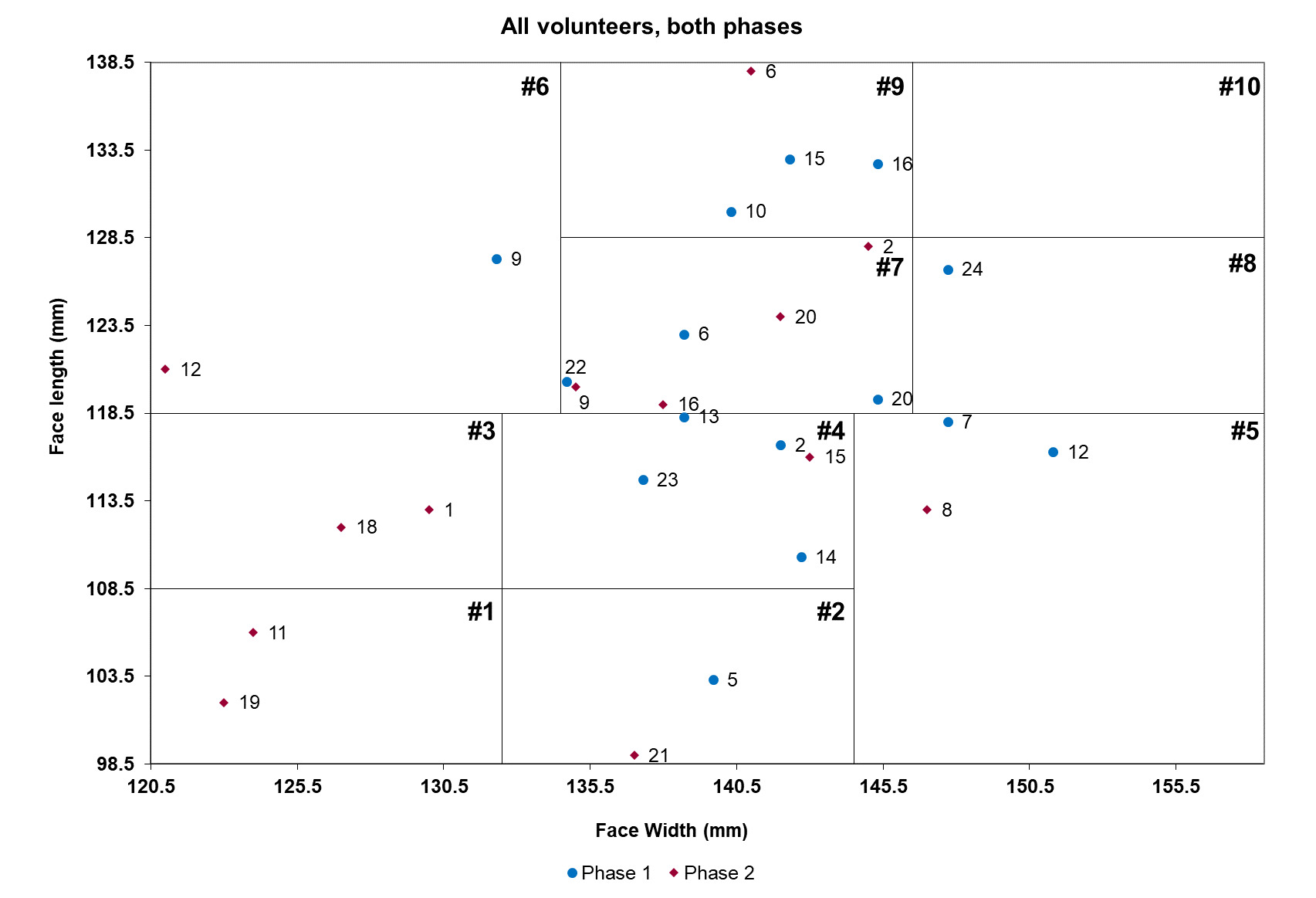
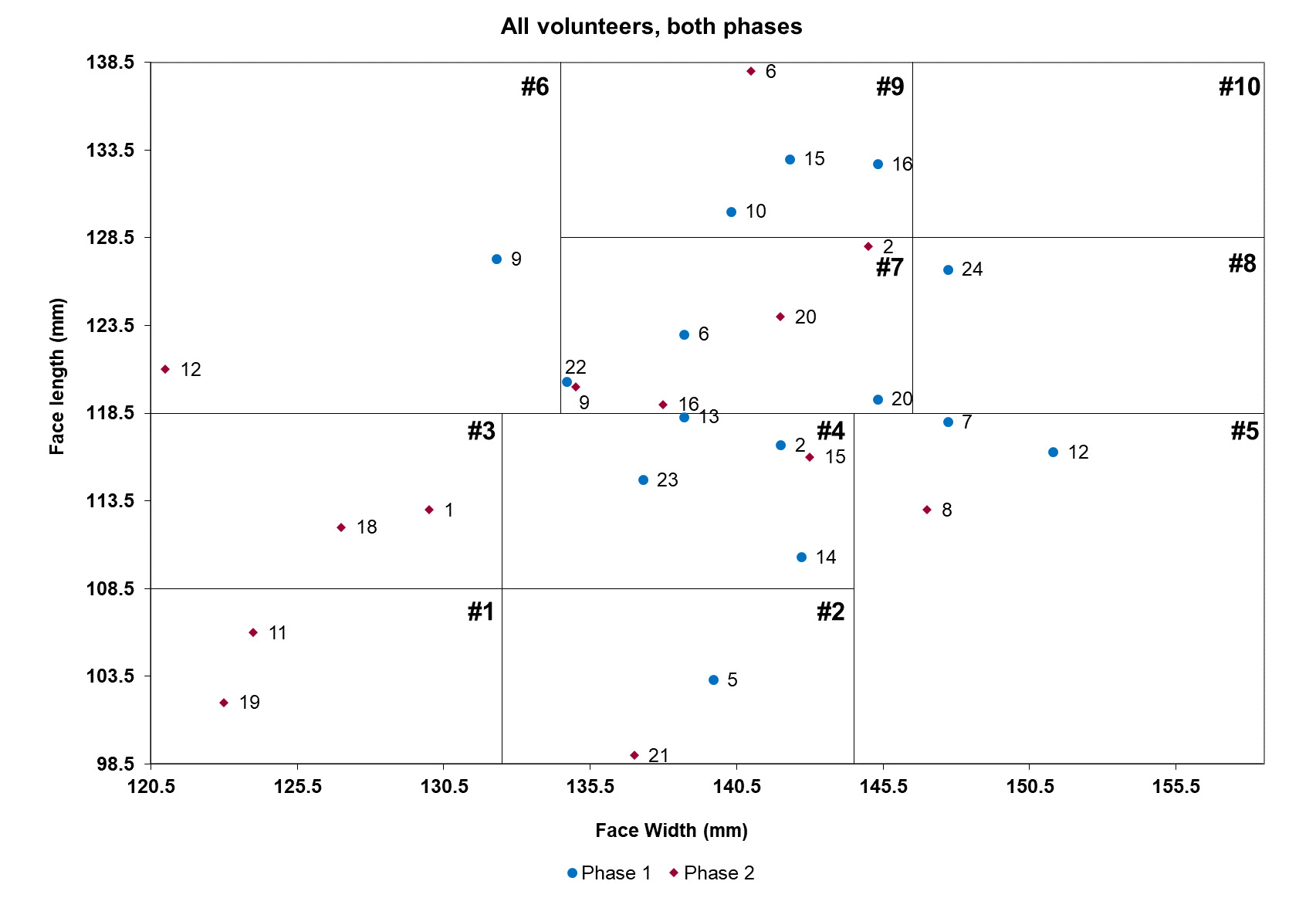
The TIL test method standard ISO 16900-1 dictates that volunteers used for testing shall be measured for face length and face width in accordance with ISO TS 16976-2 (ISO, 2022), and that only volunteers that fall inside the bivariate panel (see ISO TS 16976-2, Figure C.1) shall be used in testing. The number of suitable volunteers registered in the HSE volunteer pool was limited. Therefore, volunteers’ facial measurements were recorded, but no restrictions were made relating to bivariate panel limits.
Fit assessment of tight-fitting RPD
The tight-fitting RPD selected for this study (RPD A-D) were assessed to fit each volunteer according to HSE’s fit testing guidance INDG 479 using the quantitative ambient particle counting method. All fit tests were undertaken by Fit2Fit accredited fit testers (fit2fit, 2025).
Measurement of total inward leakage
TIL testing was carried out according to the requirements in ISO 17420-1 and the TIL test given in ISO 16900-1. There are two test methods available, test method 2A with pulsed sampling and test method 2B with continuous sampling. Pulsed sampling is preferred for tight-fitting RPD and only samples while the wearer inhales, allowing the method to negate for NaCl (sodium chloride i.e. salt) absorption inside the wearer’s lungs. Continuous sampling is used for loose fitting RPD and uses a correction factor to negate for NaCl absorption inside the wearer’s lungs. In this research, test method 2A (pulsed sampling) was employed for the tight-fitting RPD, and test method 2B (continuous sampling) was employed for the loose fitting RPD. As part of the pulsed sampling method, drying air was used in the sample line from the mask to reduce NaCl aerosol losses due to moisture build-up from the exhaled breath.
For both the methods, the in-mask and chamber concentrations were continuously measured using two separate Moore’s Low Flow sodium flame-photometers, Type 1250, and the measurements logged electronically using LabVIEW (National Instruments) software. For the pulsed sampling method, the leakage percentage (P), is the ratio of the concentrations with corrections for the pulsed sampling and the drying air and is given in Equation 2 and as specified in ISO 16900-1. For the continuous sampling method, the leakage percentage (P), is the ratio of the concentrations with correction of 1.25 applied to allow for lung retention of the NaCl and is given in Equation 3.
\[P(\%) = \left\lbrack \frac{C_{2}}{C_{1}} \right\rbrack\left\lbrack \frac{t_{in} + \ t_{ex}}{t_{in}} \right\rbrack\left\lbrack \frac{S + D}{S} \right\rbrack 100 \tag{2}\]
Where;
C1 is the test agent concentration in the enclosure.
C2 is the measured mean concentration inside the respiratory interface, corrected for background level.
tin is the total duration of inhalation (s).
tex is the total duration of exhalation (s).
D is the drying air flow rate (l/min).
S is the respiratory interface sample flow rate (l/min).
\[P(\%) = 1.25\left\lbrack \frac{C_{2}}{C_{1}} \right\rbrack 100 \tag{3}\]
Where;
C1 is the test agent concentration in the enclosure.
C2 is the measured mean concentration inside the respiratory interface, corrected for background level.
Each volunteer performed the exercises outlined in exercise regime 1 given in the TIL test standard ISO 16900-1, for each of the five RPDs. In addition, and according to ISO 16900-1, the loose fitting RPD was tested with a cross wind of 2 m/s applied to the test exercises, as detailed in Table 4.
Power assisted and powered RPD minimum flow rate
For each test, the power assisted and powered RPD were operated at the manufacturers’ minimum flow rate. This flow rate was achieved by manipulating the RPD, either by substituting the battery for an external variable power supply, and/or artificially altering the pressure drop across the filters. All modifications were carried out by the manufacturers prior to testing. The minimum flow rates for each device were measured using the test method described in ISO 16900-8 (ISO, 2015). The following minimum flow rate for RPD D was 110 l/min and for RPD E was 130 l/min.
RESULTS
Test volunteer panel
Volunteers were recruited and their facial measurements taken; these were added into the bivariate distribution panel as given in Figure 1. One volunteer in Phase 2 fell outside of the bivariate distribution panel (below the minimum face width) but still participated in testing to achieve the required numbers.
Fit testing
Fit testing was carried out on the four tight-fitting RPD for both Phase 1 and Phase 2. All volunteers passed a fit test for each of the four tight-fitting RPD in both Phase 1 and Phase 2.
Each wearer wore the same size of RPD in the TIL test that passed the fit test. The loose-fitting hood does not require fit testing; however, each volunteer’s head circumference was measured in accordance with the manufacturer’s instructions and a suitable size hood selected.
TIL testing
The percentage leakage for each exercise was calculated using Equation 2 for the tight-fitting RPD, and Equation 3 for the loose fitting RPD (as described in ISO 16900-1), and used to determine the ISO PC/PL for each RPD (as described in ISO 17420-1). For each RPD, the arithmetic mean of the leakages for all exercises was calculated and ordered from smallest to largest.
The results for Phase 1 are shown in Table 5 and ordered from least to greatest. Using ISO 17420-1, the overall percentage TILMAX value for the RPD is equivalent to the second largest result and is highlighted in gold (Test rank 14, Table 5). Only 14 results were obtained for RPD D in Phase 1 (due to limited number of volunteers that successfully passed a fit test for this RPD), an additional result was generated in Phase 2 and was imputed to Phase 1 and is marked with + (Test rank 15, Table 5). This was done to make the volunteer numbers up to 15. Only six results were obtained for RPD A in Phase 1 testing, due to limited number of volunteers that successfully passed a fit test for this RPD.
The results for Phase 2 are shown in Table 6. Using ISO 17420-1, the overall percentage TILMAX value for the RPD is equivalent to the second largest result and is highlighted in gold (Test rank 14, Table 6). Only seven results were obtained for RPD A during Phase 2 of testing, due to limited number of volunteers that successfully passed a fit test for this RPD.
Due to the limited number of volunteers available, the results for RPD A were combined from Phase 1 and Phase 2, to generate 13 percentage leakage results and ordered from smallest to largest. These are shown in Table 7. This was done so that an ISO PC/PL could be generated from the available data and comparisons made to current APFs. It should be emphasised that this is based on 13 percentage leakage results and not 15 as specified ISO 17420-1. The results marked with + are from the same volunteer that participated in both Phase 1 and Phase 2, all other results are from different volunteers. The overall percentage TILMAX value was taken as the second largest result but with only 13 results, this is highlighted in gold.
The tested RPDs were assigned ISO PC/PL according to the information given in Table 2. This is shown in Table 8 along with their TILMAX.
DISCUSSION
APF values differ between countries, but typically range between 4 and 10 000, with 4 being the lowest protection and 10 000 being the highest protection. Within each country, the APFs are specific to types/classes of RPD, i.e. a half-mask with a P3 particulate filter has an APF of 20 in the UK and 30 in Germany; whereas a class TM3 power assisted full-face mask has an APF of 1000 in Finland and APF of 40 in the UK. Generally, APFs from different countries increase from lower to higher when moving through filtering facepieces, half-masks, full-face masks, powered and air supplied RPD. The APFs are used by the wearers to select an appropriate RPD to provide adequate protection against inhalation of hazardous substances in the workplace. They help reduce residual exposures to below relevant OELs (where established), in conjunction with other control measures.
APFs for each type/class of RPD are based on data generated in WPF, SWPF, application of safety factors to nominal protection factors, and the use of professional judgement. The ISO system will introduce six ISO PCs and corresponding ISO PLs as PC1 PL4, PC2 PL10, PC3 PL30, PC4 PL250, PC5 PL 2000 and PC6 PL 10 000. The ISO PC/PL will be determined by a laboratory TIL test and not by WPF studies. ISO PC/PL values can be assigned to any type and class of RPD, meaning, for example, a half-mask with a P3 particulate filter from two different manufacturers could have different ISO PC/PLs, all based on the performance during TIL testing. Equally, a full-face mask with a P3 particulate filter(s) and a power assisted full-face mask could have the same ISO PC/PL as each other (this is the case with the current UK APF values, but typically across many countries, the APF of a power assisted full-face device is higher than a non-powered full-face device).
The intention of this study was to compare current APFs with the new ISO PL/C system, by gathering initial validation data on five different types of RPD, to determine their ISO PC/PL values, based on the requirements in ISO 17420-1 and the TIL test given in ISO 16900-1.
The following ISO PLs were determined:
-
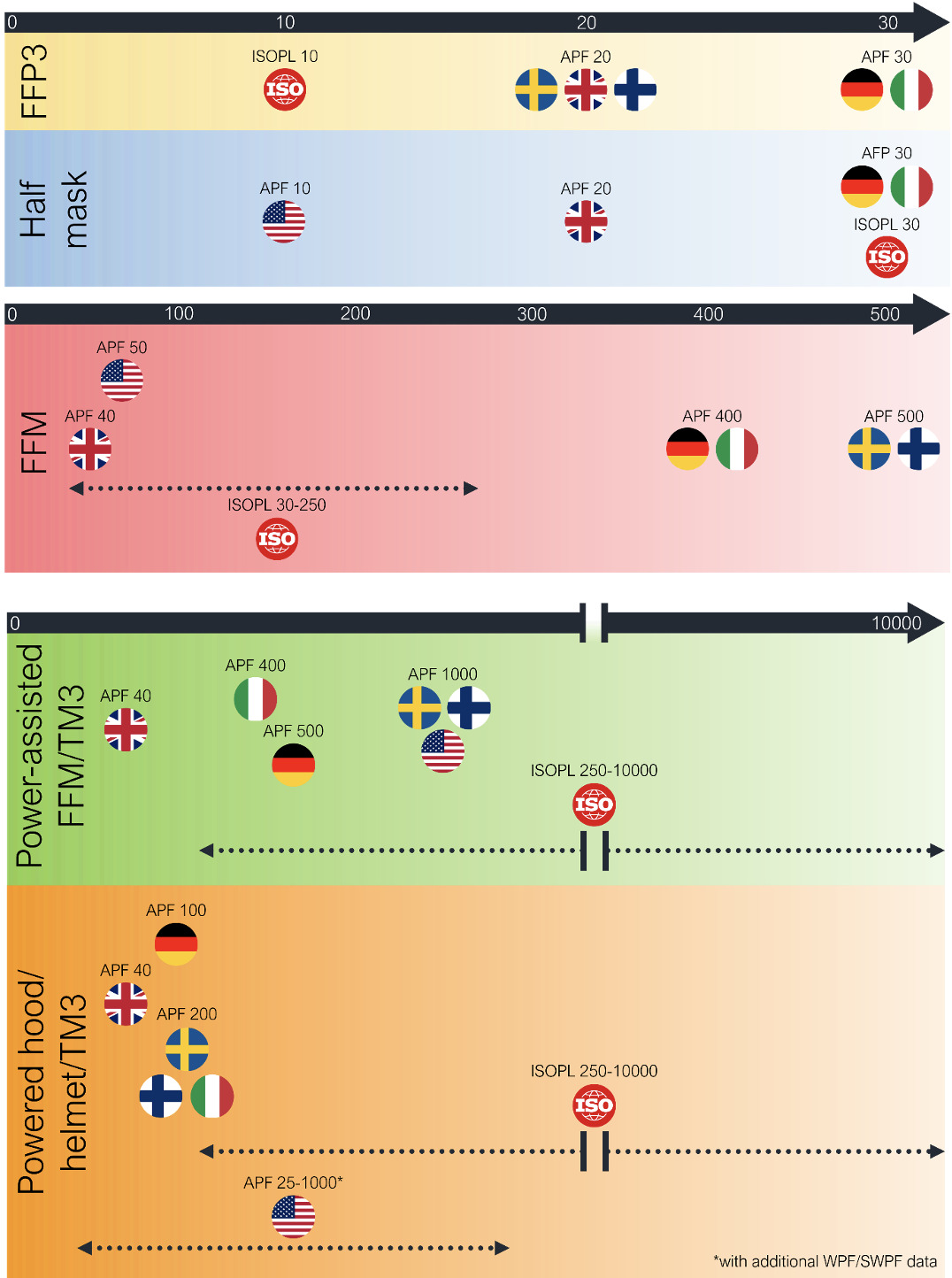
For RPD A, data for Phase 1 and Phase 2 of testing had to be combined to generate data for a total of 13 volunteers. This gave an ISO PL of 10 compared to APFs ranging from 10–30 for this type and class of RPD. This is shown visually in Figure 2.
-
The data for RPD B gave an ISO PL of 30 for both phases of testing, compared to APFs ranging from 10–30. This is shown visually in Figure 2.
-
The data for RPD C gave an ISO PL of 30 (Phase 2) and 250 (Phase 1), compared to APFs ranging 40–500. This is shown visually in Figure 2.
-
Data for RPD D gave an ISO PL of 250 (Phase 2) and 10 000 (Phase 1), compared to APFs ranging from 40–1000. This is shown visually in Figure 2.
-
The data for RPD E gave an ISO PL of 10 000 (Phase 1) and 250 (Phase 2), compared to APFs range from 40–200 (or 1000 in the US with additional WPF/SWPF data). This is shown visually in Figure 2.
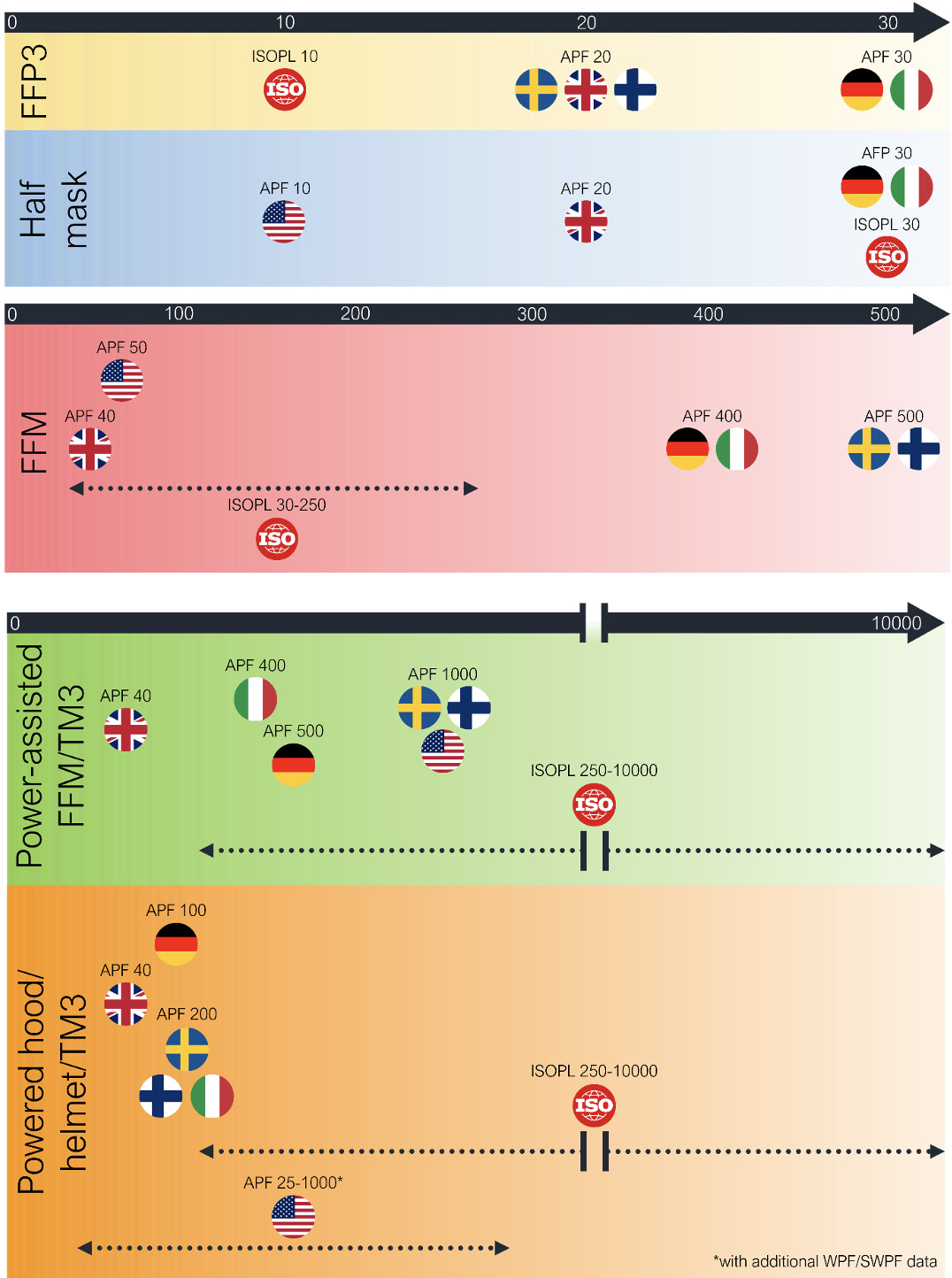
There are differences in the ISO PLs generated in this study compared to the current APFs. Comparison of the ISO PL data against current APFs depends on the country being considered, given the variation in APFs across countries. For FFP3s, the APFs across different countries are similar, ranging from 10–30, and are similar to the ISO PL of 10 generated in this study. However, the difference between an ISO PL of 10 and APF of 30 (Germany and Italy) could be significant in terms of the protection expected for the wearer. For example, if an FFP3 was selected in Germany with an APF of 30 to reduce any residual exposure to below an OEL, an ISO PL of 10 for the same device may not be high enough to reduce the residual exposure below that OEL. In this situation, a higher-performing RPD, or an increase in the performance of other control measures may be needed to reduce the residual exposure to below the OEL.
A similar trend is seen for half-mask RPD, with similar APFs across different countries ranging from 10–30, compared to an ISO PL of 30 generated in this study. However, the difference between an ISO PL of 30 and APF of 10 (US) could have an impact on the protection provided to the wearer in the opposite direction. For example, if a half-mask was selected in the US with an APF of 10 to reduce residual exposures to below a certain OEL, an ISO PL of 30 for the same device could be considered to provide more than enough protection. In this situation, an RPD with a lower ISO PL, may be considered enough to reduce the residual exposure to below the OEL.
There was variation between Phase 1 and 2 when determining the ISO PL for the same full-face mask RPD (RPD C). Phase 1 gave an ISO PL of 250 which is higher than the APFs of both the UK (40) and US (50), but is lower than Germany and Italy (400) and Finland and Sweden (500). Phase 2 gave an ISO PL of 30 which is similar to but lower than the APFs used in the UK and US (40 and 50, respectively), and much lower than the APFs of Germany and Italy (400) and Finland and Sweden (500). This shows inconsistency with the ISO PL generated for the same RPD type in two different testing phases by the same testing group. This again, as discussed previously, could have an impact on the type of RPD selected to reduce any residual exposure below a certain OEL.
There was variation in the ISO PLs generated in this study for the same power assisted full-face mask RPD. Phase 1 of testing gave an ISO PL of 10 000, which is much higher than all current APFs. Phase 2 of testing gave an ISO PL of 250, which is higher than the APF of 40 used in the UK, but lower than the APFs of 400 (Italy), 500 (Germany) and 1000 (US, Finland, and Sweden). This could impact the protection considered to be provided to the wearer, similar to those discussed above.
There was variation in the ISO PL generated in this study for the same powered with hood/helmet RPD. Phase 1 of testing gave an ISO PL of 10 000, which is much higher than all current APFs. Phase 2 of testing gave an ISO PL of 250 which is higher than the APF of 25 and 40 used in the US and UK respectively, similar to the APFs of 100 (Germany) and 200 (Italy, Finland and Sweden), and lower than the APF of 1000, which can also be used in the US with additional WPF study data.
The ISO PL data generated for the power assisted with full-face mask RPD and powered with hood/helmet RPD have shown the biggest differences to the current APFs used. For example, if a powered with hood/helmet RPD was selected in the US with an APF of 25 to reduce residual exposures to below a certain OEL, an ISO PL of 10 000 for the same device would be expected by the employer/wearer to provide far more protection. In this situation, the same RPD with an ISO PL of 10 000, would be expected to provide a significantly greater reduction in residual exposures. Also, the same RPD with an ISO PL of 10 000 may be used, in conjunction with appropriate control measures, to protect the wearer against much higher residual exposure levels.
The variations in ISO PL (both higher and lower) generated in this study, compared to current APFs, highlights a different approach to using (and selecting) RPD to control residual exposures to the wearer. Under the ISO PL system, when used in conjunction with other control measures, a RPD may appear to provide more, or less protection (when compared to the current APF system) to reduce residual exposure. These variations will need careful consideration for inclusion in national guidance if it is decided to change from the current APF system to the ISO PL system.
This research has shown differences in the ISO PLs generated between Phase 1 and Phase 2 for the same types of RPD. The testing was performed according to the same test method and procedure, but Phase 1 and Phase 2 were carried out seven months apart, suggesting there could be an inherent variation in TIL testing.
A possible explanation for these variations in ISO PLs for the same RPD types could be that different volunteers were used between Phase 1 and Phase 2. Of the volunteers that were used, three were common across both phases of testing. The facial dimensions shown in Figure 1 gives a general spread of more volunteers from Phase 1 being in the smaller bivariate cells (numbers 1, 2, 3, and 4) compared to more volunteers from Phase 2 being in the larger bivariate cells (numbers 7, 8, 9, and 10). It is easy to presume that each volunteer will have different breathing rates during the test exercises, due to variables such as age and physical fitness. Depending on how well the RPD was fitting to the volunteer during each individual test, variations in the breathing rate could have an effect on the measured leakage i.e. during a specific test, if the RPD did not fit the volunteer well and they had a high breathing rate, then it is reasonable to presume that the leakage measured could be higher than if the RPD did fit well and the breathing rate was low. However, we made every effort to mitigate this by having each RPD selected to fit each volunteer, either by carrying out a fit test for the tight-fitting RPD or by following the manufacturers guidance for the loose fitting RPD. Each volunteer was also given training on how to don the RPD in accordance with the manufacturer’s instructions and a pre-use wearer seal check was performed in an attempt to get the best fit on the RPD for the volunteer. This, however, is not a guarantee that each volunteer fitted the RPD in the same way for each test.
There are some limitations to this study which were not anticipated at the outset, and which should be considered in any future research carried out. Due to the limited number of volunteers that were available and that were also deemed to fit the RPD, the same volunteers were not used across the two phases of testing, and there was not an even distribution of facial sizes across the bivariate panel. The limited number of volunteers also meant that the ISO PC/PL was generated using 13 volunteers instead of 15 volunteers. The limitation of volunteer numbers should be considered for any other laboratory and any impacts of on ISO PL certification in the future. There was no assessment on any correlation to the ISO PL generated and the assessment of fit of the RPD by quantitative fit testing.
The new ISO PL concept is different from the current APF system, which is currently understood and utilised by technical experts, national regulators and end users. Under the ISO PL system, any type of RPD can effectively have any classification of ISO PL, and that there can be any ISO PL assigned to the same type of RPD from different manufacturers i.e. a full-face mask from manufacturer A could be assigned an ISO PL of 30, while a full-face mask from manufacturer B could be assigned an ISO PL of 250. This is different from all full-face masks having the same APF in a particular country irrespective of the manufacturer or demonstrated performance in TIL testing.
There is limited research on the validation of the new ISO PL system on the whole range of RPD available. Only five types of RPD were tested in this study, meaning that there are still several types of RPD that have no validation data. Given the variation in ISO PL observed in this study, further validation testing is required across a range of institutes and test laboratories for these five types of RPD and others. It would also be useful to undertake WPF or SWPF studies. Further research would provide valuable validation to input into the relevant standards committees and national regulators when considering any adoption of the ISO PL system. The authors believe that this work is a starting point for more research studies into this topic, particularly given the planned adoption of the ISO PL system by Australia by 2030.
CONCLUSION
Initial ISO PL validation data was generated for five different types of RPD (filtering facepiece, half-mask, full-face mask, power assisted with full-face mask and powered with hood/helmet). Consistent ISO PL data was obtained for RPDs that are conventionally considered to be lower-performing, specifically RPD A and RPD B. The ISO PLs corresponded similarly with current APFs across different countries. However, variations in ISO PL between Phase 1 and Phase 2 testing were seen for RPD C, RPD D and RPD E.
Under the ISO PL system, an RPD is classified by its performance during laboratory TIL testing. There is no TIL pass/fail requirement in the ISO performance standards, only use of the TIL results to determine the appropriate ISO PC/PL. In theory any RPD type can be classified with any ISO PC/PL. This research demonstrated that RPD A and RPD B types varied by one protection class between the two different testing phases (ISO PLs of 10–30), whereas RPD C, RPD D and RPD E types varied by two protection classes which substantially impacted the assigned ISO PLs varying from 30–10 000.
This is an initial study to look at the ISO PLs for RPD. Further validation testing is essential on the same types of RPD tested in this study and also across the whole range of RPD types currently available to enable standards committees and national regulators to make decisions to incorporate the ISO PL system into national standards. It would be highly beneficial if further validation was carried out by other institutes and laboratories which would also include different volunteer panels.
DISCLAIMER/ACKNOWLEDGEMENT
This publication and the work it describes were funded by the Health and Safety Executive (HSE). Its contents, including any opinions and/or conclusions expressed, are those of the authors alone and do not necessarily reflect HSE policy.
ACKNOWLEDGEMENTS
The authors wish to acknowledge the support given by HSE staff who kindly volunteered to be test subjects, without whom the project could not have been completed.